The digital landscape continues to move at a rapid pace, with SMEs continuing to struggle to navigate these changes. We don’t envy this. We see the effects of rising costs, evolving cyber threats, shortages of in-house skills and outdated infrastructures. All of which are placing huge pressure on SMEs who are operating with limited resources.
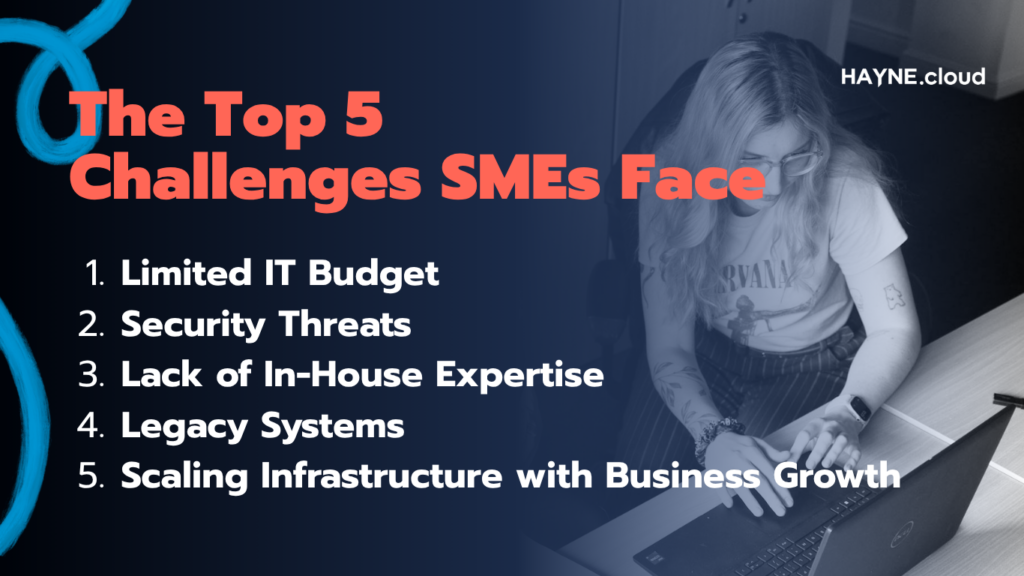
Below we will address the 5 most common challenges we are seeing SMEs face in 2026, along with further resources for you to dive into if any of these areas you may relate to what you are experiencing.
Limited IT Budget
Many small and medium-sized businesses are facing limited IT budgets. In the current economic climate, this is completely understandable. Rising costs mean IT investment is often delayed.
As a result, many SMEs rely on outdated hardware and legacy IT systems. These systems are slower, harder to support, and not built for modern ways of working. Over time, this can reduce productivity and increase security risks.
Older technology also makes it harder to adapt to change. Employees may struggle with slow devices, poor collaboration tools, and systems that no longer work well together. This can hold the business back and create frustration across teams.
A Managed Service Provider (MSP) offers a practical solution for businesses with tight IT budgets. Instead of large upfront costs, an MSP helps you get more value from what you already have.
Many businesses already pay for tools in Microsoft 365 but don’t use them fully. An MSP can review your setup and unlock features that improve security, productivity, and collaboration – often at no extra cost.
An MSP can also:
- Optimise your Microsoft 365 licences
- Improve performance on existing hardware
- Reduce downtime with proactive IT support
- Offer predictable monthly IT costs
- Plan future improvements without overspending
With the right MSP support, IT becomes easier to manage and easier to budget for. You gain modern, secure systems without stretching your finances.
Security Threats
Cyber-attacks and security threats continue to be one of the most palpable risks to SMEs, with research indicating that nearly half of all UK businesses experienced a cyber breach in 2025.
The reason this is so key to SMEs is that smaller businesses are often more targeted due to hacker reliance on limited resources leading to weaker security systems and defence. This also lends into the assumption of missing or having untested disaster recovery plans. Without proper security and efficient recovery processes, and ransomware attack or hardware failure can lead to detrimental data loss.
The SMB Guide to Microsoft 365 Security and Compliance
Lack of In-House Expertise
We are seeing a lot of SMEs struggle due to not having dedicated IT resources, depending on over-worked staff or experience limitations – battling to manage overly complex systems. More often than not, this results in security gaps, technology blocks and misconfigurations.
Legacy Systems
Outdated systems and slow operations can result in much more than SMEs may realise, and these expenses can creep up bit by bit. Maintenance costs, exposures to security threats, support renewals and urgent calls to IT when something breaks at the worst time.
Over time these costs stack up, and a business can end up exposed and spending more just to keep things running, rather than focusing on anything new and productive.
Industry reports regularly encourage that legacy technology is a direct blocker of digital transformation, efficiency in operations and ultimately the overall customer experience
Scaling IT Infrastructure with Business Growth
As an SME grows, the IT systems need to scale up. Many businesses either outgrow their tools or outgrow their support providers. A rising trend in 2026 is that businesses with existing MSPs find they either:
- Become “just another number” to a provider that has grown too large to deliver dedicated support
- Become a business their MSP is longer capable to handle due to their increasing technical needs as a growing business
This is a commonly experienced mismatch, and often leads to poor service, an increase in response times, reduced strategy, unnecessary add-on sales and systems that no longer align the companies’ operational needs.
Scaling infrastructure requires expert guidance with proactive planning, and without this a lot of SMEs are risking growth due to gaps in reliable capability.
Summary
The IT challenges SMEs face in 2026 are significant. Tighter budgets, outdated systems, rising security threats and the pressure to scale without exhausting already limited resources. These problems are proven to slow a business down and increase operational risk – making it even harder to focus on growth.
However, these issues are fixable. The right strategy and people that support and understand the realities SMEs are dealing with, can transform IT. Improved efficiency can create a foundation that supports long-term progress rather than hinder it.
At HAYNE.cloud, we like to follow a ‘no-nonsense’ conduct. We dedicate 30 minutes for you to speak directly with the team to pinpoint exactly where your IT is working, and where it isn’t. We don’t believe in unnecessary add-ons, generic recommendations and pushes to fix was isn’t broke. We consider ourselves an extension to your team, working with you to tailor a plan that suits you and your specific business, goals and challenges. Nothing less.
If you’re ready to cut wasted spend, strengthen your security and make your IT work with your business rather than against it, our team is here and ready to help.
Get in touch with our team to discuss how we can help you move forward with clarity, confidence, and a technology strategy that supports long term growth.